Marietta approves 18 MW data center 5-2 after heated hearing
Months of opposition came to a head Wednesday night as residents shouted from the chamber and police escorted a man away from the microphone before Marietta City Council approved the Powers Ferry data center rezoning 5-2.
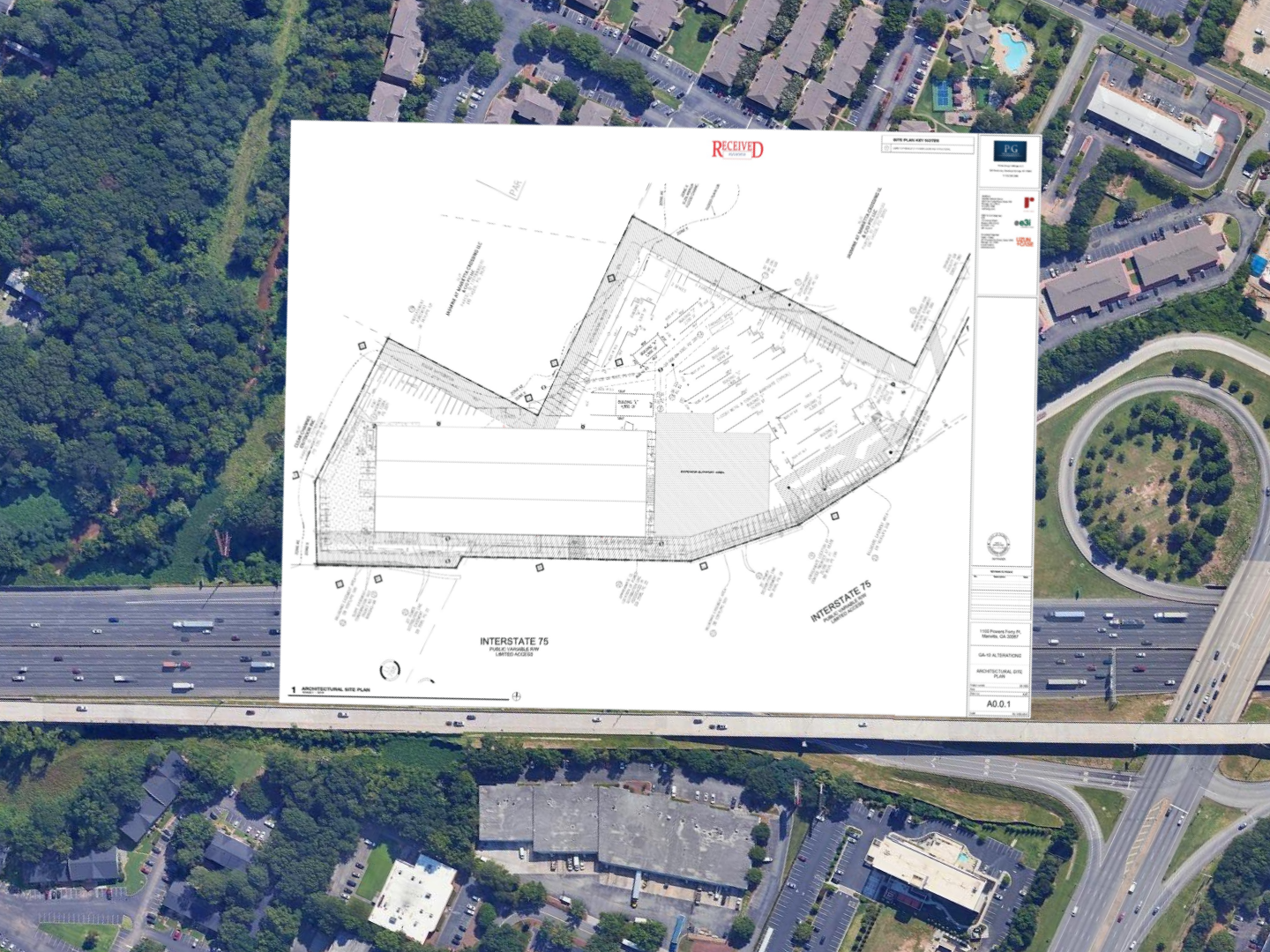
Applicant-submitted site plan for 1155 Powers Ferry Place overlaid on aerial imagery. Source: City of Marietta / Prime Group Holdings.
The rezoning allows part of an existing Prime Storage property at 1155 Powers Ferry Place to be converted into an 18-megawatt data infrastructure facility. The 10.727-acre site sits immediately east of I-75, with the Elme Apartments directly northeast of the property.
The property is owned by an affiliate of Prime Group Holdings LLC, a Saratoga Springs, New York-based private equity real estate firm and operator of the Prime Storage platform. Prime Group founder and CEO Robert Moser appeared before council Wednesday to argue that the proposed facility should not be viewed like a traditional large-scale data center.
What happened
Wednesday's vote followed more than a month of public opposition and increasingly close scrutiny from Marietta officials.
The Planning Commission had recommended approval of Z2026-12 by a narrow 4-3 vote. When the project reached City Council in July, council voted 7-0 to delay a decision.
That same night, Marietta adopted a six-month moratorium on new data center applications. Because the Powers Ferry application was already in the pipeline, it was allowed to continue through the rezoning process.
By the time the case returned Wednesday, tensions inside City Hall were high.
Residents shouted from the chamber after public comment was closed. One man rushed forward to the microphone to question what he said were four pages of redacted materials in the application before police escorted him away. Council members warned that attendees continuing to disrupt the hearing would be asked to leave.
"Our voices need to be heard," one resident shouted.
"This is where our children go to school. We are the people who need to be heard," another said.
The opposition centered heavily on whether an 18-megawatt computing facility was compatible with the surrounding area.
Marietta planning staff had already concluded that it was not consistent with the city's Comprehensive Plan.
The property is designated Regional Activity Center, a future land-use category intended for medium- and high-intensity commercial and office development. Staff wrote that data centers operate more like industrial facilities because of their large-scale mechanical equipment, continuous electrical demand and exterior support areas.
"Therefore, this rezoning request does not align with the City's Comprehensive Plan," the staff analysis concluded.
Staff also noted that Marietta's zoning ordinance does not currently define data centers as a separate use or establish standards specifically governing their equipment and operations. The analysis said additional technical information would be needed to evaluate potential impacts from equipment, noise and screening on surrounding properties.
Cobb County resident Louis Smith, who said he has spent his career in information technology, questioned the location directly.
"Never in my years in this career have I visited a data center that was surrounded by neighborhoods," Smith told council.
Noise became one of the central technical questions before the vote.
Council asked Marietta Public Works Director Mark Rice for his opinion on the applicant's sound study. Rice made clear that he is not a sound engineer, but pointed to a limitation in what had been presented.
"The data you are seeing is not indicating all the equipment running at one time," Rice said.
The issue was particularly relevant because staff had already identified continuously operating cooling and electrical systems as potential sources of steady mechanical noise. Residential property immediately northeast of the site is subject to Marietta's nighttime residential noise limits.
Attorney Parks Huff responded by offering additional noise protections as zoning conditions.
Huff said the project would use constant acoustic monitoring and agreed to an independent acoustic study after the facility begins operating.
"We would agree to a, within 6-9 months, an independent acoustic study and if there are any deficiencies we would bring it into compliance," Huff said.
Huff also offered to make compliance with Marietta's nighttime noise limits a zoning condition, including during emergency operating conditions.
The written application describes sound barriers and equipment enclosures intended to reduce acoustic impacts. It also says the project would use a closed-loop air-cooled system rather than increasing water consumption, with the applicant funding required utility infrastructure improvements.
But Prime Group CEO Robert Moser made a broader argument: he disputed whether the project should be thought of as a traditional data center at all.
Moser described the facility as "last-mile compute," arguing that its purpose is to place computing resources close to the people and systems using them.
"This is not a data center, it's purely inference," Moser said.
He contrasted the project with larger facilities designed to process workloads for users across much wider geographic areas.
"A data center is set up where land is cheap, power is cheap, and can be used for anyone in the world or 10 states over. What this does is for the benefit of the residents."
That argument closely tracks the project's written application, which says the facility is intended to provide computing close to end users where latency matters, citing applications such as traffic-control automation and medical-facility operations.
The applicant also emphasized that the project is an adaptive reuse rather than construction of a new hyperscale campus. The proposal would convert part of the existing building while retaining much of the self-storage operation, with exterior infrastructure concentrated primarily on existing paved portions of the site.
After a 4-3 Planning Commission recommendation, a unanimous delay, a new citywide data center moratorium and another heated public hearing, Marietta City Council approved Z2026-12 by a 5-2 vote.
What to watch
The rezoning decision resolves Z2026-12, but the broader question of how Marietta regulates data centers remains open.
City staff specifically noted that the current zoning ordinance does not distinguish between different types or scales of data centers and does not contain standards tailored to their equipment or operations. Staff identified the case as an example of a use the city may want to address through future zoning-code updates.
For the Powers Ferry project itself, the next issue will be how the commitments discussed Wednesday are incorporated into the final zoning conditions and implemented through permitting, particularly the proposed acoustic monitoring, independent sound study and continued compliance with nighttime noise limits.
For Marietta, the vote leaves a larger policy question behind: how should the city distinguish between the kind of localized "last-mile compute" facility described by Prime Group and the larger data centers its new moratorium was designed to address?
LandScout tracks rezoning cases across growth markets for land, development and acquisition teams.
Sources
- City of Marietta: Z2026-12 application packet and staff analysis
- City of Marietta: August 12, 2026 City Council meeting video
- Prime Group Holdings: company and leadership information
Case record
- Owner
- Prime Storage Powers Ferry Place
- Parcels
- 17078700110